

Breakages in a holiday rental: who pays for what?
A plate slips, a blind jams — it happens to everyone on holiday. When something breaks in a rented property, the question comes up quickly: who has to pay? The rule is fairly simple. Just look at what caused the damage:
- The damage comes from misuse: the guest pays.
- The damage comes from wear and tear, the age of the item or a poor-quality product: the owner pays.
Here is what that means in practice.
What the law says
Holiday letting is governed mainly by the French Civil Code and by the rental agreement. Three articles set out the essentials:
- Article 1732: the guest is liable for damage and losses occurring during the stay, unless they can show these were not their fault.
- Article 1755: the guest does not pay for repairs caused by age-related wear or by force majeure.
- Articles 1719 and 1720: the owner must let a property in good condition and cover repairs that go beyond ordinary use by the guest.
In short, the guest pays for what they damaged. The owner pays for what wears out or fails on its own.
Concrete examples
| Situation | Who pays? | Why |
|---|---|---|
| A glass or a plate broken while washing up | Nothing is charged to the guest (see below) | Minor breakage, normal during a stay |
| Wine spilt on the sofa, a burn on the worktop | Guest | Misuse or lack of care |
| An electric blind forced by hand, a patio door pulled off its rail | Guest | Abnormal use |
| A key, a gate remote or a badge lost | Guest | Lost during the stay |
| A toilet cistern leaking because the seal is 10 years old | Owner | Age-related wear |
| Air conditioning that fails without having been misused | Owner | Wear or a fault in the unit |
| A cheap frying pan losing its coating, a sun lounger giving way after two seasons | Owner | Poor-quality product |
| A sagging mattress, curtains faded by the sun | Owner | Normal wear |
The tricky cases: take a frying pan scratched by a metal utensil. Is that misuse, or a pan that was too fragile? In cases like these we look at the condition of the item, its age, and we apply common sense.
Broken glasses: we do not charge for them
A guest who has paid for a week’s holiday is not going to receive a €3 invoice for a glass. At RIBOLEYS we made a simple choice: everyday minor breakage is part of the normal running costs of a rental. Broken glasses, plates and cups are not charged to guests.
At the end of the season we replace the crockery in complete sets — six identical glasses at once, for instance. So there is never a mismatched set, and the property keeps its well-kept look. For the owner it is a small renewal budget planned every year, like linen or cleaning supplies.
Wear and tear: no paying new-for-old
Even when the guest is liable, they do not necessarily pay the price of a brand-new item. Wear and tear is taken into account — that is, the age of the item and its normal lifespan.
Example: an 8-year-old sofa is stained beyond repair. The guest should not pay the price of a new sofa. They should pay a reasonable share matching the remaining value of the sofa.
Quality equipment: good arithmetic for the owner
Let us compare two sun loungers:
- A €25 lounger usually lasts one season. And it tends to give way in the middle of August. You then have to buy a new one and pay for an emergency call-out to replace it while the guests are there.
- A quality lounger at €130 lasts about five years, with no nasty surprises in high season. And well-known brands often come with a manufacturer’s warranty of several years: if it breaks without misuse, it is repaired or replaced free of charge.
Looking at the purchase price alone, the two cost roughly the same per year. But as soon as you add an emergency call-out, the cheap lounger works out more expensive. And that is before the other benefits of quality equipment:
- the manufacturer’s warranty, which covers a good share of failures;
- more comfortable guests, who leave better reviews;
- fewer disputes: sturdy equipment rarely breaks, and when it does the cause is easier to establish.
The same goes for the frying pan, the blind, the bedding or the garden furniture: equipment that lasts costs less to use.
A well-kept property is a respected property
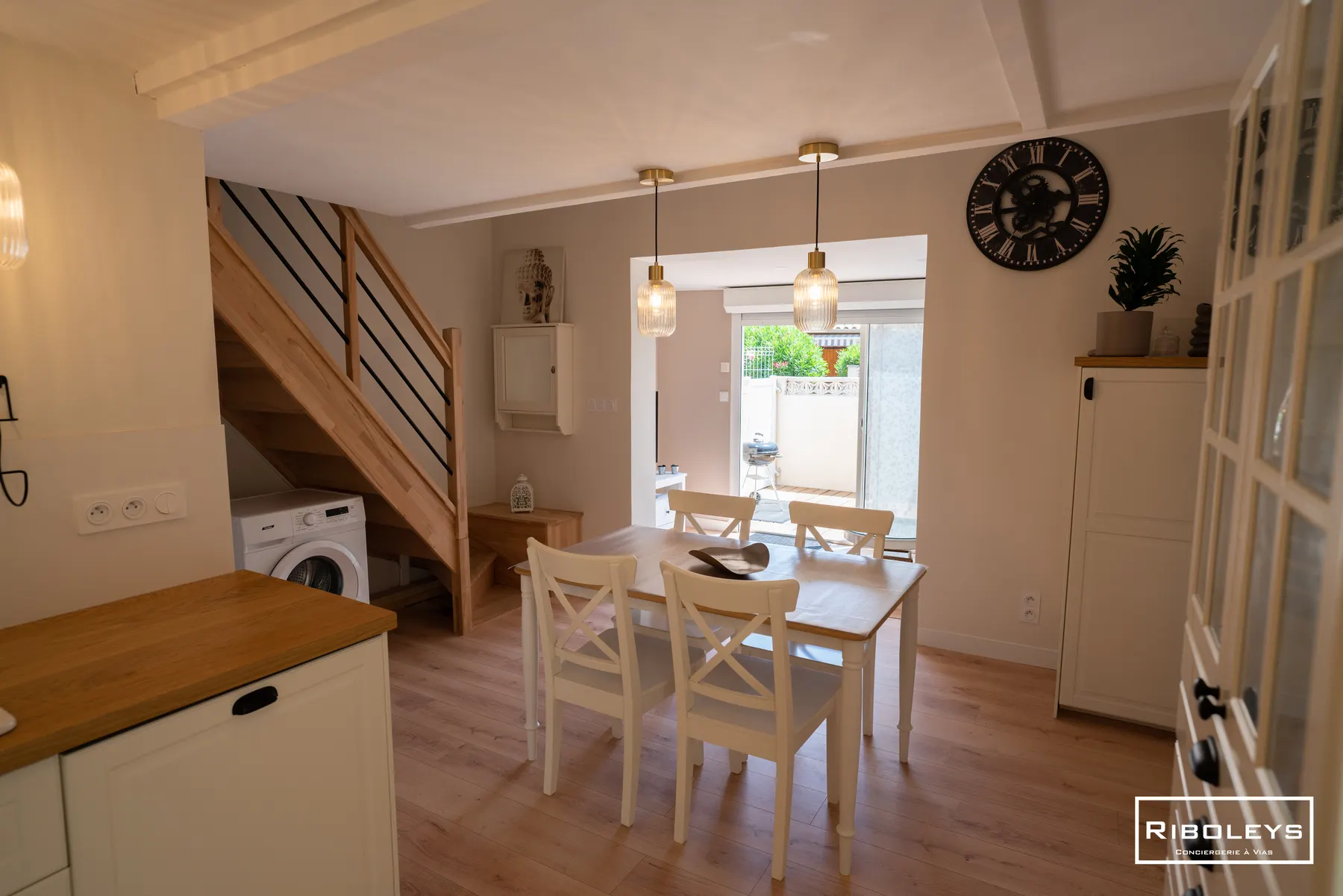
We see it every season: the better maintained and equipped a property is, the more care guests take of it.
People tidy up and pay attention in a clean, well-decorated interior with good equipment. It feels like staying with friends, not passing through. Conversely, damaged furniture or mismatched crockery give the impression that “it doesn’t really matter”. And the property deteriorates faster.
It is a virtuous circle:
- a well-kept property attracts guests who are looking for quality and are ready to pay a fair price;
- those guests look after the property and leave better reviews;
- good reviews keep occupancy high and rates healthy.
Maintaining and equipping a property properly is not an extra expense. It is the best way to protect it.
In practice: the inventory, the deposit and reporting problems
Three things matter for everything to go smoothly between guest and owner:
- The signed inventory. The property is checked item by item and the guest signs the inventory. That establishes what is present and in good condition at the start of the stay.
- A window to report a problem. If the guest notices something missing or faulty on arrival, they have until midnight on their arrival day to tell us. They cannot then be held liable for what they reported.
- The security deposit. It is there to cover genuine damage for which the guest is liable. Any deduction must be justified (invoice or quote) and proportionate to the actual damage. Wear and tear must be taken into account.
Our frequently asked questions also cover damage, the deposit and cleaning, from the owner’s point of view.
And if something breaks during the stay, the best thing is to tell us straight away. Most of the time it is sorted out in two minutes.
What about insurance?
For the guest: holiday liability cover
Many home insurance policies include holiday liability cover (“garantie villégiature”) or tenant’s liability for holiday stays. It can cover damage caused to the rented property, such as water damage or a fire. Do check with your insurer before you travel. Some premium bank cards also offer cover, but it is often more limited.
Careful: cancellation insurance does not cover breakages. They are two different things.
For the owner: non-occupying owner cover and holiday-let policies
- Non-occupying owner insurance (PNO) is compulsory in a co-owned building. It covers damage caused to neighbours and incidents for which the guest is not liable, among other things. Check carefully that your policy covers holiday letting: it does not always, and the exclusions can be significant.
- Some insurers offer policies designed specifically for short-term letting. They cover furniture, loss of rent and vandalism.
- Water damage in a co-owned building: the IRSI convention, an agreement between insurers, generally appoints the occupier’s insurer to handle the claim. One more reason to keep policies up to date.
Platform guarantees
- Airbnb (AirCover for Hosts): the cover can reimburse up to 3 million dollars of damage caused by a guest. The claim must be filed within 14 days of check-out. It must first be raised with the guest through the Resolution Centre, who then has 24 hours to respond. Normal wear and tear is excluded.
- Other platforms tend to offer optional deposits or more limited guarantees. They are no substitute for real insurance.
Remember: platform guarantees are a safety net, not a full insurance policy. Good non-occupying owner cover remains essential.
How we work at RIBOLEYS
For the properties we manage in Vias, here is what we do:
- an inventory checked item by item and signed by the guest, who has until midnight on the day of arrival to report a problem;
- no invoice for minor breakage: the crockery is replaced in complete sets at the end of every season;
- equipment advice for owners: sturdy products, often under warranty, that last several seasons;
- a direct conversation with the guest when genuine damage occurs, and claims filed with the platforms when needed.
Our aim is to protect the owner’s property and stay fair to guests who, most of the time, are very careful.
In brief
- Damage caused by misuse: the guest pays, with wear and tear taken into account.
- Damage caused by wear or a poor-quality product: the owner pays.
- Everyday minor breakage (glasses, plates): part of the normal running costs of a rental, and not charged.
- Quality equipment: it lasts longer, it is often under warranty and it avoids emergency call-outs.
- A well-kept property: guests take more care of it, it deteriorates less and it lets better.
- The signed inventory: the best tool there is for avoiding disputes.
- Insurance: holiday liability cover for the guest, non-occupying owner cover suited to holiday letting for the owner, and platform guarantees on top.
Thinking about renting out a property in Vias? Get in touch with RIBOLEYS.